Validation Checklist by Type of Online Business
Practical checklist to validate each online business type, detect risks and decide whether to move towards deeper due diligence.
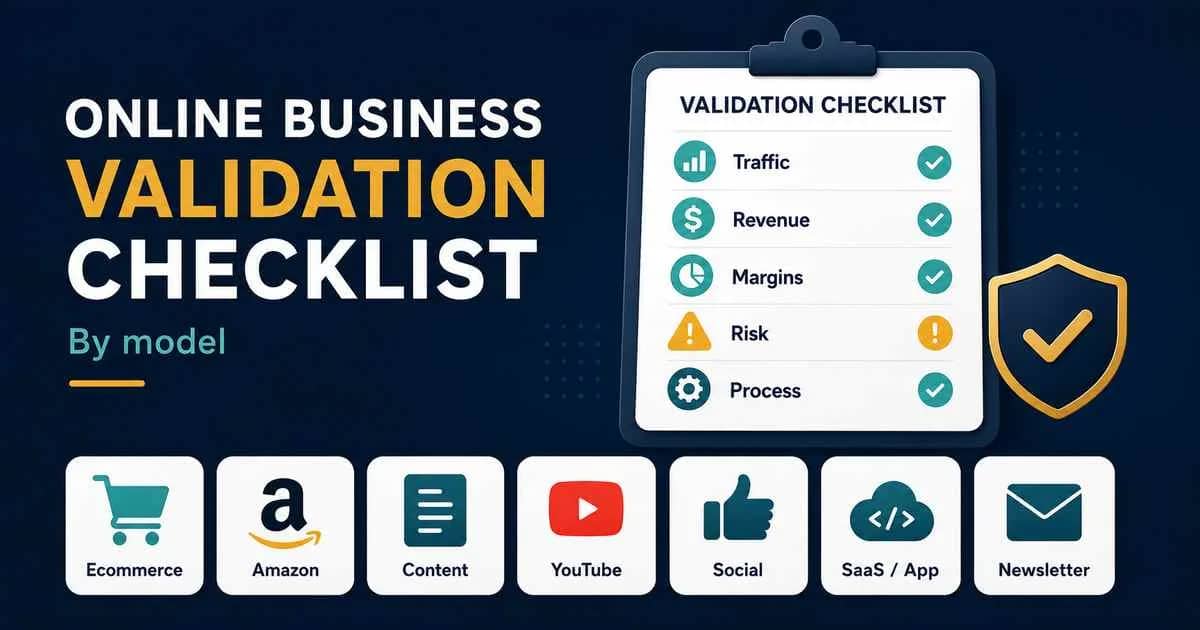
Not all digital businesses are analysed in the same way. Each model has its own metrics, risks and validation points. Evaluating an ecommerce business with the same criteria as a content website, a YouTube channel or a SaaS can lead to incomplete conclusions.
This checklist is designed as a practical tool for buyers who need to review an opportunity with judgement before moving forward in a negotiation or starting a deeper due diligence process.
The objective is not to replace a full financial, legal or technical analysis, but to help detect which aspects should be reviewed in each type of business and which signs may indicate a higher level of risk.
Summary of key areas by business type
1. Ecommerce
An ecommerce business should be analysed from three angles: traffic acquisition, real profitability and operational capacity. Turnover alone is not enough. A business may sell a lot and still have weak margins, hidden costs or an operation that is difficult to sustain.
Before moving forward with an ecommerce business, it is worth checking that the declared profit reflects all real costs. It is also important to understand whether growth depends on investing more in advertising or whether there are more stable channels, such as SEO, email marketing or customer recurrence.
2. Amazon FBA / FBM
Businesses based on Amazon should be reviewed with special attention to account health, product quality, ranking stability and inventory management. Dependency on the platform is high, so any problem in the account can directly affect the value of the business.
On Amazon, reviewing sales and profit is not enough. The continuity of the business depends on factors the buyer does not fully control: Amazon policies, competition, ranking changes, reviews and inventory availability.
3. Content and affiliate websites
Content and affiliate websites are often attractive because of their light structure and their ability to generate revenue with few operating costs. However, they depend heavily on organic traffic, content quality and commission stability.
In this type of business, the key question is whether traffic and revenue are defensible. A website with many visits can lose value quickly if it depends on a few pages, if the content is outdated or if the niche has become too competitive.
4. YouTube
A YouTube channel should be analysed beyond the number of subscribers. What matters is the stability of views, the quality of the audience, RPM, dependency on the creator and the ability to keep publishing content without losing identity.
The main risk on YouTube is usually transferability. If the audience follows the creator more than the channel, the buyer must assess whether they will be able to maintain production and preserve user interest.
5. Instagram and TikTok
Instagram and TikTok accounts can have high reach, but their valuation should be especially prudent. The number of followers is not enough to justify a purchase. Audience quality, real engagement and the ability to monetise are much more important.
On social media, an account with a good audience is not always a good business. The buyer must check whether there is a clear and repeatable way to convert that attention into revenue.
6. SaaS and apps
A SaaS or an app should be validated by combining financial, technical and product analysis. Recurrence can justify attractive valuations, but only if users stay, the product works properly and the technology is maintainable.
In SaaS and apps, the buyer must understand what they are really buying: a user base, a technology, a brand, a recurring cash flow or a combination of all of these. If the technical side is not clear, it should be reviewed before moving forward.
7. Newsletters and memberships
Newsletters and membership communities depend on the relationship with the audience. Their value lies in trust, recurrence and the ability to maintain the editorial proposition after the purchase.
In this model, the transfer must be planned carefully. The buyer needs to preserve the audience's trust and maintain content quality to avoid cancellations or loss of interaction.
8. Final questions before moving forward
After reviewing the model-specific checklist, it is useful to make one final general check. These questions help decide whether it is worth moving towards full due diligence.
Each model requires its own validation
Each type of online business requires a different validation. The information that matters in an ecommerce business is not the same as in a YouTube channel, an affiliate website, a TikTok account or a SaaS.
A professional buyer adapts the analysis to the model being evaluated. They review the right metrics, identify critical dependencies, check the quality of revenue and assess whether the price reflects the real risks.
The purpose of this checklist is to make that first structured filter easier. If an opportunity passes this initial review, it will make more sense to dedicate time to deeper due diligence, negotiate conditions and assess whether the acquisition fits the buyer's strategy.