Multiple Analysis: How to Know Whether a Business Is Overpriced or Undervalued
Manual for analysing multiples, profit, risk, stability and price before buying an online business with solid investment judgement.
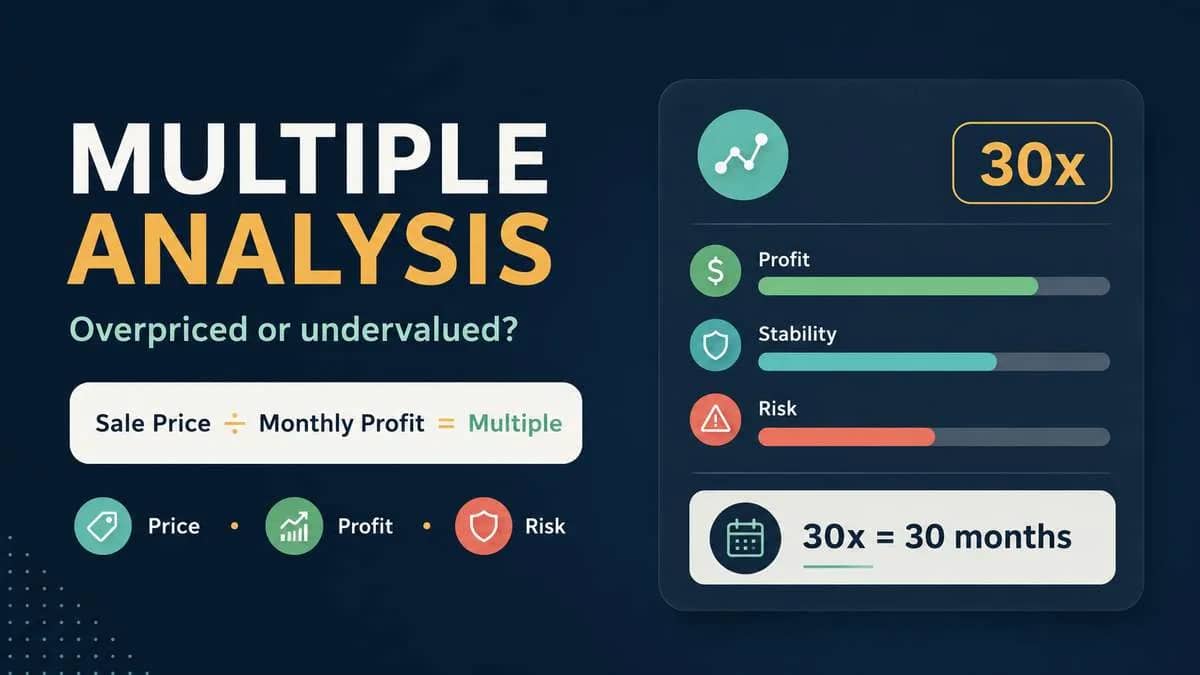
The multiple is one of the most widely used references for valuing an online business. It makes it possible to relate the sale price to the profit generated by the business and helps estimate, in a simple way, how many months would be needed to recover the investment if results remained stable.
However, the multiple should not be analysed as an isolated number. Two businesses with the same monthly profit can have very different valuations if one is stable, diversified and easy to operate, while the other depends on a single channel, one product or one specific person.
For that reason, the multiple should always be interpreted in relation to risk, stability, business model, age, quality of revenue and real growth margin.
1. What the multiple is and why it matters
In the buying and selling of digital businesses, the multiple acts as a practical way to convert profit into price. It does not determine by itself whether a transaction is good or bad, but it helps put the price into context.
The most common formula is: Sale price divided by average monthly profit equals the multiple.
For example, if a business generates €3,000 in monthly net profit and is sold for €90,000, the multiple would be 30x. In simple terms, the buyer would need 30 months to recover the investment if the business maintained the same profit and there were no relevant changes.
This calculation is useful, but it has limits. Not all profits have the same quality. Stable profit over several years does not have the same value as recent, irregular profit or profit concentrated in a few good months.
2. The multiple as a reflection of risk
The multiple usually reflects the perceived risk of the business. The more stable, predictable and transferable an asset is, the easier it will be to justify a high multiple. By contrast, the more dependent, volatile or difficult to operate it is, the more prudent the valuation should be.
A business with recurring revenue, documented processes, diversified traffic and low dependency on the owner may sell at a higher multiple. On the other hand, a business with recent revenue, unstable traffic or strong dependency on the seller should be valued more cautiously.
The general rule is simple: the higher the risk, the lower the multiple; the greater the stability, the higher the multiple.
3. Factors that help interpret the multiple
Before deciding whether a business is overpriced or undervalued, it is worth reviewing the factors that explain the multiple applied. This table summarises the main elements that should be analysed.
4. Indicative ranges by business type
Multiple ranges vary according to the market, the quality of the asset and the specific moment of the transaction. Even so, they can serve as an initial reference for detecting whether a valuation is within reasonable parameters.
These ranges do not replace an individual analysis. An ecommerce business with a strong brand, healthy margins, organic traffic and clear operations can justify a higher multiple than another ecommerce business that depends almost entirely on paid campaigns. In the same way, a SaaS with high churn and little stability should not be valued in the same way as one with recurring revenue, loyal customers and a consolidated product.
5. When a business may be undervalued
A business is not undervalued just because it has a low multiple. Sometimes a low price reflects important risks. At other times, however, a real opportunity may exist if the business is undervalued due to lack of optimisation, poor presentation or the seller's need for liquidity.
Some signs that may indicate an interesting opportunity are:
- Stable traffic with monetisation that can be improved.
- A good product, but poor commercial presentation.
- Reasonable margins with costs that can be optimised.
- Simple processes that could be documented and delegated.
- Acquisition channels that have not been worked on.
- An underused customer base.
- Non-existent or underdeveloped email marketing.
- Good organic positioning with outdated content.
- A seller with little time to continue operating the business.
In these cases, the buyer should not focus only on the apparent discount, but on their real ability to execute the improvements needed. An opportunity is only good if the buyer can convert that potential into results.
6. When a business may be overpriced
A business may be overpriced even if the multiple seems reasonable. This happens when the price does not properly reflect the risks, instability or additional capital that will be needed after the purchase.
Some signs of overvaluation are:
- Recent or inconsistent profit.
- Valuation based on exceptional months.
- Dependency on a single page, product, video or campaign.
- Traffic falling or without a clear explanation.
- Limited transparency in access or metrics.
- Lack of operational documentation.
- High dependency on the founder.
- A very volatile or excessively competitive niche.
- Need for additional investment not reflected in the price.
When several of these signs appear, the buyer should review the valuation with caution. The problem is not always the price itself, but the lack of relationship between price and risk.
7. How to adjust the multiple according to business dependency
Dependency is one of the factors that most influences valuation. A business may have good results, but if those results depend on one critical element, the risk increases.
The most common dependencies are:
- A single traffic channel.
- One single supplier.
- One product that concentrates most sales.
- One main customer.
- Ads campaigns without enough history.
- Content closely linked to the founder's image.
- A developer or technical team that is difficult to replace.
The more concentrated the business is, the more prudent the multiple should be. Diversification does not eliminate risk, but it reduces the probability that one single problem will seriously affect the whole business.
8. How to value businesses that depend on advertising
Businesses based on paid advertising require especially careful analysis. They can be very profitable, but also sensitive to changes in costs, audiences, creatives, competition and platforms.
Before accepting a valuation, it is worth reviewing:
- Real campaign history.
- ROAS and net margin after advertising costs.
- Dependency on specific creatives.
- Evolution of cost per acquisition.
- Ability to scale budget without losing profitability.
- Quality of the conversion funnel.
- Whether campaigns are documented or depend on the seller's judgement.
A business dependent on Ads is not necessarily a bad opportunity. The key point is to check whether performance is stable, replicable and understandable. If it only works under very specific conditions, the multiple should reflect that risk.
9. How age influences valuation
Age does not guarantee quality, but it does provide context. A business with several years of results makes it possible to analyse cycles, seasonality, market changes and resilience when problems arise. A young business may be interesting, although it normally involves more uncertainty.
As a general reference:
- 0 to 12 months: high risk, limited history and more prudent multiples.
- 12 to 24 months: intermediate risk, provided there is sufficient stability.
- More than 24 months: greater ability to analyse and possibility of justifying higher multiples.
Time alone is not enough. An old business with falling revenue may be less attractive than a younger one with solid metrics. What matters is assessing age together with trend and data quality.
10. Quick signs for reviewing a valuation
Before making an offer, this table can serve as a quick check to detect whether the price appears reasonable or requires deeper review.
11. How to know whether the price is reasonable
To assess whether a price makes sense, it is worth combining the multiple calculation with a broader review of the business.
Some useful questions are: Is the profit used to calculate the multiple representative?
Does the business have enough history?
Does the price reflect the risks detected?
Does the transaction require additional investment after the purchase?
Is the model transferable without depending too much on the seller?
Are the growth opportunities concrete or only theoretical?
Are there comparable businesses with similar multiples?
Do the payment or support conditions reduce part of the risk?
A reasonable price is not necessarily the lowest one. It is the price that maintains a balanced relationship between profit, stability, risk, potential and transaction conditions.
The multiple only makes sense within the full context of the business
The multiple is a useful tool for analysing the price of an online business, but it should not be used mechanically. Its real value lies in helping interpret the relationship between price, profit and risk.
A business may appear cheap and hide important problems. It may also appear expensive and be well valued if it has stability, recurrence, clear processes and low transition risk.
The key is to review the multiple within the complete context of the business: model, history, dependencies, documentation, capital required and real growth capacity. Only then is it possible to distinguish between a well-valued opportunity, a risky purchase or an asset with real potential.