Mini Due Diligence Guide to Buy an Online Business
Mini due diligence to validate revenue, profit, traffic, assets, risks and operations before buying an online business.
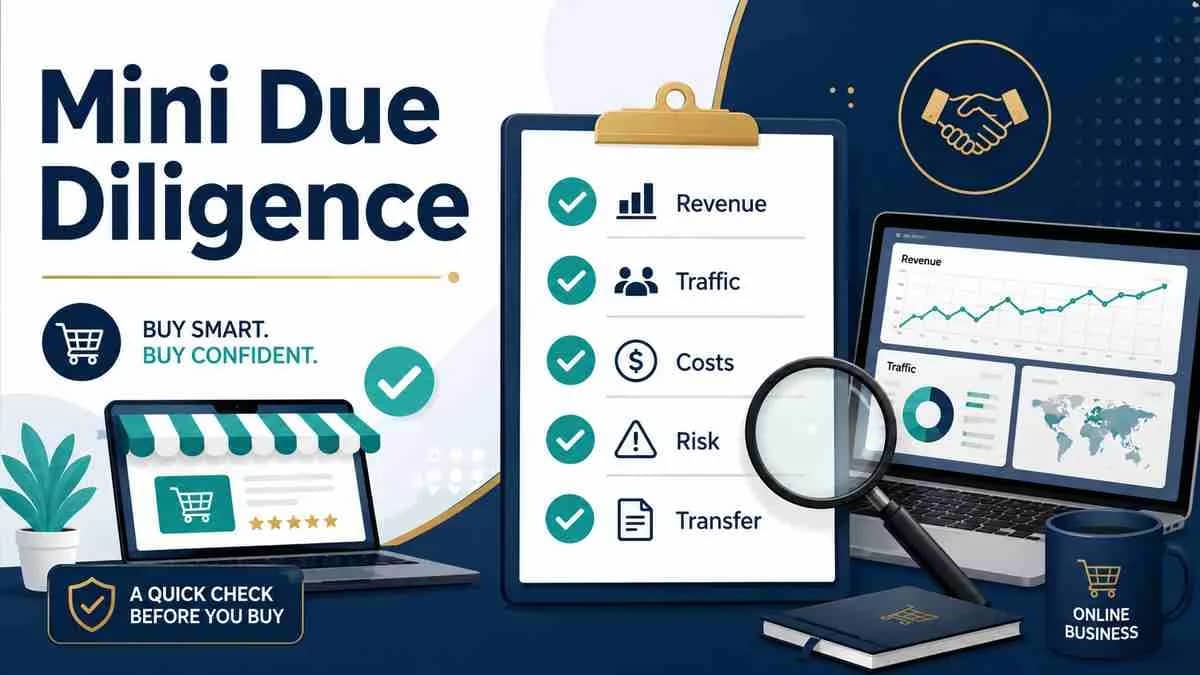
Buying an online business should not be done only because the numbers look attractive, the multiple fits or the seller inspires confidence. Before signing, the essentials must be checked.
That is the function of a mini due diligence: validating the points that really matter in a digital acquisition without turning the process into an unnecessarily complex audit.
Not all businesses require the same level of review. An ecommerce business, an affiliate website, a SaaS, a YouTube channel or an Amazon account have different particularities. But they all share something: if the revenue is not real, if the profit is wrongly calculated, if the traffic depends on one weak point, if operations cannot be transferred or if the assets are unclear, the transaction can go wrong.
A well-executed mini due diligence does not seek to complicate the purchase. It seeks to separate a reasonable opportunity from a purchase based on expectations.
The problem appears when the buyer focuses only on the headline: "it generates €2,000 per month", "it requires few hours", "it has organic traffic", "there is a lot of potential". Those phrases may be true, incomplete or misleading if they are not verified.
This document brings together the essential points that should be reviewed before buying an online business, regardless of the model or the size of the transaction.
What a mini due diligence should answer
A well-focused review should answer five questions:
If important doubts remain after reviewing these points, the transaction is not ready. This does not necessarily mean it must be rejected, but it does mean information is missing to decide with judgement.
1. Start by checking revenue
The first question is simple: does the business really generate what the seller says?
Seeing a screenshot is not enough. A screenshot may be incomplete, outdated or show only a favourable part of the business. Ideally, revenue should be checked directly in the platforms where it is generated: Shopify, WooCommerce, Stripe, PayPal, Amazon Seller Central, AdSense, affiliate programmes, course platforms, marketplaces or equivalent tools.
The review should be carried out month by month. Not only to know how much the business earns, but to understand how that revenue behaves.
A business that bills €3,000 per month steadily for a year is not analysed in the same way as one that billed €9,000 one month, €800 the next and €1,200 after that. The average may look attractive, but the operational reality is very different.
What to review:
- Monthly revenue over the last 6-12 months, or the available period if the business has less history.
- Exact platforms where that revenue is generated.
- Consistency between dashboards, statements and documents provided.
- Anomalous months and explanation of those peaks or drops.
- Whether revenue is recurring, one-off or seasonal.
A common example: an ecommerce business that multiplies sales in November and December is not necessarily more valuable because of those months. It may simply be seasonal. If the price is calculated using its best months, the buyer may be paying for a reality that does not repeat throughout the year.
2. Profit matters more than turnover
Turnover is usually the figure that attracts the most attention. Net profit is what determines whether the business is worthwhile.
A business can sell a lot and leave little. It can also sell less and do so with a light structure, healthy margins and low operational workload. For that reason, the mini due diligence should look at profit more carefully than revenue.
The seller may present estimated profit, but the buyer must check which costs have been included and which have not.
Costs that are often forgotten or minimised:
- Advertising.
- Platform and payment gateway commissions.
- Tools and subscriptions.
- Hosting, plugins, apps or software.
- Product cost.
- Logistics and returns.
- Freelancers or external support.
- Content production.
- Customer service.
- Stock replenishment.
- Technical maintenance.
An apparently minor cost can change profitability significantly. A tool costing €80 per month does not seem relevant until real profit is €600. An occasional freelancer may seem unnecessary until it is discovered that this person was the one keeping content, ads or the website working.
The right question is not "how much does it bill?", but: "how much remains after paying everything necessary for the business to continue operating?".
3. Review stability, not just the last month
The last month may be good, bad or irrelevant. A purchase should not be based on an isolated snapshot.
Historical evolution helps understand whether the business grows, remains stable, declines or depends on specific moments. It is not necessary to analyse every financial detail at this stage, but it is necessary to detect the trend.
A frequent warning sign is that the seller calculates the price using a period that is too favourable: the last three months, a one-off campaign or the high season. To value well, it is better to use a representative average profit, not the most attractive part of the chart.
4. Check where buyers, users or visits come from
After validating revenue and profit, it is necessary to understand how customers arrive. An online business depends on traffic, audience, campaigns, rankings, marketplaces, email, recommendations or community.
The key question is: is the channel that generates sales stable and transferable?
In a content website, this may mean reviewing Google Analytics and Search Console. In ecommerce, reviewing SEO, Ads, email, social media and direct traffic. In Amazon FBA, analysing ranking, reviews, searches and campaigns. In YouTube or social media, reviewing views, reach, engagement and creator dependency.
The dangerous thing is not depending on a channel. Many businesses depend on one. The dangerous thing is not knowing it or paying as if the risk did not exist.
What to review:
- Main traffic or sales sources.
- Weight of each channel in revenue or leads.
- Evolution over recent months.
- Dependency on a single page, product, campaign, video or marketplace.
- Quality of traffic: intent, conversion, recurrence and origin.
- Whether the channel will be transferable to the buyer.
A clear example: a website may have 50,000 monthly visits, but if 80% of profit comes from two articles positioned in Google, the risk is very different from that of a website with traffic spread across many URLs. The same happens with an ecommerce business that depends on one Meta Ads campaign or a YouTube channel sustained by three viral videos.
5. Understand the work behind the business
Many listings say "requires few weekly hours". That phrase should be treated as a hypothesis, not as a truth.
The seller knows the business, has internalised its habits and probably solves many things without considering them work. The buyer, on the other hand, will have to learn everything: tools, suppliers, customers, incidents, passwords, metrics, campaigns, stock, content and pending decisions.
For that reason, the mini due diligence should review the real operation.
Useful questions: Which tasks does the seller carry out each day, week and month?
Which tasks are essential to maintain revenue?
What part can be delegated from the first month?
Are there written processes or does everything depend on verbal explanations?
What happens if the buyer is absent for one week?
Which incidents repeat most often?
Which suppliers, freelancers or tools are critical?
It is not only about knowing how many hours the business requires. It is about understanding what type of hours they are.
Dedicating five hours to reviewing metrics and coordinating tasks is not the same as dedicating five hours to putting out incidents, answering complaints, fixing technical errors or chasing suppliers.
6. Validate the assets that are really transferred
A purchase can become complicated if it is not clear what is included. In online businesses, assets are usually spread across platforms, accounts, tools, domains, content, databases and third-party relationships.
Before signing, it is worth listing exactly what is transferred and what is not.
Special care must be taken with assets that seem part of the business but are not always transferable: the seller's personal accounts, corporate email, social media linked to their identity, non-transferable licences, images without clear rights or supplier relationships based on personal trust.
What is not transferred should not be part of the value paid.
7. Review dependency on the seller
A business can work very well while the seller is inside. The question is whether it will continue working when the seller leaves.
Seller dependency appears in many forms. Sometimes it is visible: they are the face of the channel, serve customers or negotiate with suppliers. Other times it is less evident: they know technical details, manage campaigns "from memory", create content with a style that is hard to replicate or solve incidents without documenting them.
Signs of high dependency:
- The seller appears as a central figure of the brand.
- There is no process documentation.
- Supplier relationships depend on them personally.
- Customer service requires their constant judgement.
- Campaigns or SEO are not documented.
- Content depends on their voice, image or experience.
- There is no team or freelancers who know the operation.
When dependency is high, there are three options: negotiate post-sale support, adjust the price or not move forward. Ignoring it is usually expensive.
A good question for the seller is: "If you stopped participating tomorrow, which parts of the business would be affected first?" The answer often reveals more than many metrics.
8. Carry out a technical review proportionate to the business
Not all businesses require a deep technical audit. But all require a minimum review of what could prevent the buyer from operating normally.
In a website or ecommerce business, the basics are knowing whether the platform is in good condition, whether access is controlled, whether there are critical plugins or tools, whether hosting works well and whether there are serious security, speed or maintenance problems.
In a SaaS or app, the technical side weighs more. There it is worth reviewing code, infrastructure, dependencies, documentation, maintenance costs and who can resolve incidents after purchase.
In social media or YouTube, the technical review focuses more on the account: warnings, strikes, copyright, authenticity of followers, access, history and platform risks.
The technical review must be proportionate. The aim is not to turn the purchase into an impossible audit, but to detect problems that may block business continuity.
9. Do not ignore the legal side
The legal side is often treated too lightly. That is a mistake. The process does not need to be complicated, but it is necessary to confirm that the buyer will receive what they believe they are buying and that they will not inherit avoidable problems.
Basic points:
- Ownership of the domain and digital assets.
- Usage rights for images, texts, videos, music or creatives.
- Trademark registration, if it exists.
- Contracts or agreements with suppliers and freelancers.
- Privacy and data protection compliance.
- Transfer conditions for accounts and tools.
- Possible claims, disputes or pending incidents.
- Which responsibilities remain before and after the purchase date.
A frequent example: a website may have hundreds of images taken from the internet without clear licence. Perhaps nothing has happened so far, but the risk exists. Another common case is a brand used for years without registration and with a name that is difficult to protect.
The legal mini due diligence does not have to be sophisticated. It must answer one simple question: will the buyer be able to exploit the business without encountering an ownership, rights or compliance problem shortly after buying it?
10. Evaluate the seller, not only the business
The seller is part of the transaction risk. Their transparency, speed, order and willingness to help say a lot about what the transition will be like.
A professional seller does not need to have everything perfect, but they should answer clearly, provide reasonable documentation, recognise risks and explain why they are selling.
Positive signs:
- They respond with data and not only opinions.
- They explain weak points without trying to hide them.
- They provide access or verifiable evidence.
- They have a coherent reason for selling.
- They are willing to facilitate post-sale support.
- They understand the business metrics well.
Warning signs:
- They avoid specific questions.
- They pressure to close quickly without giving information.
- They change versions about revenue, costs or tasks.
- They do not want to show basic access or documentation.
- They present everything as opportunity and nothing as risk.
- They cannot explain well how their own business works.
A transaction with a decent business and a seller who is not transparent can become complicated. Due diligence also serves to measure trust.
11. Adjust the price if risks appear
Due diligence is not only used to decide whether to buy or not. It is also used to negotiate better.
If risks appear during the review that were not reflected in the listing, the buyer can propose adjustments: lower price, more post-sale support, conditional payments, earn-out, retention of part of the payment or specific conditions in the contract.
Not every finding justifies a discount. Some simply clarify the transaction. But if risk changes the expected profitability, it should be reflected in the negotiation.
12. Final checklist before signing
Before moving to the contract, the buyer should be able to mark the essential points as reviewed.
If any important answer is still weak, it is worth resolving it before signing. Haste rarely improves an acquisition.
13. When to ask for external help
A mini due diligence can be carried out by the buyer if they understand the model and know how to interpret the information. But there are situations where it is worth asking for external support.
It is advisable to seek help when:
- The price is relevant to the buyer's wealth.
- The business has a technical side the buyer does not understand.
- Revenue depends on Ads, SEO or a specific platform and the buyer does not know how to analyse it well.
- There are contracts, licences, intellectual property or sensitive personal data.
- The seller provides confusing information.
- The transaction includes stock, team, debt, complex accounts or deferred payments.
- The buyer cannot distinguish between a minor alert and a serious risk.
Asking for help does not mean complicating the process. Sometimes a specific expert review prevents paying too much, assuming unnecessary risks or rejecting an opportunity that did make sense.
The best due diligence is not the longest, but the one that validates what matters
A useful due diligence does not consist of reviewing documents by inertia. It consists of checking the points that can change the purchase decision.
Revenue must exist. Profit must be real. Traffic must be understood. Operations must be transferable. Assets must be clear. Risks must be reflected in the price or in the conditions.
That is the core of a well-executed mini due diligence.
The buyer does not need to know everything before buying. But they do need to know enough not to depend on a promise. Buying with judgement does not eliminate all risks, but it avoids the most expensive ones: paying for inflated revenue, underestimating operational workload, inheriting hidden problems or discovering too late that the business depended on something that could not be transferred.
The final decision should not be based on the business "looking good". It should be based on what can be verified, transferred and operated after the purchase.