Sales Funnel or Sales Funnel: Everything You Need to Know
What is a sales funnel? A sales funnel is a process used to guide potential customers through a series of steps, from the first contact to the final sale on a website. The goal of a sales funnel is to ensure that all potential visitors receive the same mes
What is a sales funnel?
A sales funnel is a process used to guide potential customers through a series of steps, from the first contact to the final sale on a website. The goal of a sales funnel is to ensure that all potential visitors receive the same message and have the same opportunities to make a purchase.
In other words: 1- we set a goal, whether that is selling an item or simply collecting a lead's details
2- we study the different stages a user would go through until reaching that goal.
It will be easier to understand by looking at a sales funnel example.
Let's imagine we run an ecommerce business that sells toys; a possible sales funnel could be:
Lead generation, where does our buyer persona enter?
Notice that they could come in through, among others:
- Through social media: Instagram, TikTok, Facebook…
- Through lead generation campaigns: Facebook Ads, Google Ads…
- Through organic website traffic: SEO
Once they are on our website, what do we do to get their details?
We can use several methods. The 2 most common are:
- Newsletter subscription
- Entry banner with discount codes
When they click on a product, what stages of the buying process do they go through until they complete payment?
These are the possible stages a lead could go through in this example; keep in mind that at any of them we could lose them:
- click to buy the item
- visit another product or products
- click on the shopping cart
- enter a discount code
- fill in personal details
- fill in bank details
- abandon a product
- abandon the cart
- complete a purchase
What do we do if they drop off at each of the previous stages?
Email marketing / remarketing actions to bring them back to our website.
What do we do once we close a sale?
Reward or loyalty actions.
All these steps could easily be a sales funnel for many online sales companies. As you can see, the important thing is to gather information from our potential customers at each stage of the funnel and then, using email marketing techniques, be able to close a sale or achieve the goal we have set. The sales team can also help define that goal.
Determining the different stages of our sales funnel is not an easy process. If you have started a company, you will have realized that it takes time and that you do not really know your customer. That is normal; very few people start a company knowing their customer base 100%. Let’s put it in their words: it commands respect, or even fear. But don’t worry, nobody gets a perfect funnel on the first try. Spend a few minutes reading this article and go ahead and create your own. Later on, we will give you the tools we use to build a good sales funnel.
Why is it important to have a sales funnel?
There are many reasons to invest in a good sales funnel, but the most important one is that it helps your business grow. A good funnel makes it possible to generate more sales and, therefore, more profit.
In addition, a sales funnel will allow you to measure the effectiveness of all the marketing strategies you are implementing. You will get to know your ideal customer, you will know which stage of the sales process each lead is in, and you will be able to detect the bottlenecks so you can improve them.
Finally, a good sales funnel is the foundation for effective content marketing. If you do not know who you are targeting, it will be difficult to offer the right content at each stage of the sales process.
How do you create a sales funnel?
There are many ways to build a good sales funnel and, really, the best way is the one that fits your business. However, there are certain steps you should follow to create a good funnel:
1- Identify the ideal customer
The first thing you should do is identify your ideal customer. To do this, you can use a tool like Google Analytics or SEMrush.
2- Final goal
Once you know your buyer persona, you must determine the funnel's final goal. Do you want to sell a product? Get subscribers for your newsletter? Get a phone number or email from the lead? This will depend on your type of business. For example, a company that sells online courses may be more interested in getting subscriptions, so one of its KPIs will be to get X subscriptions by the end of the month. Therefore, its online sales goal is not to sell a product but to get subscriptions.
3- Study the stages
Next, we study the different stages a user would go through until reaching that goal. To do this, use tools that help you create diagrams. A very good free one is Gloomaps.
4- Content
The next step is to create the right content for each stage. With the diagram previously studied, now is the time to take action. Develop banners, discounts, remarketing emails, etc. Show all your strengths so the lead becomes a customer.
5- Measure results
Finally, all that is left is to measure the results and continuously improve the funnel.
How to measure a sales funnel
The best way to measure a funnel is by using Google Analytics. With this tool, you can see the number of conversions that have occurred at each stage of the funnel and, therefore, detect the bottlenecks.
Another way to measure a sales funnel is by using marketing automation tools such as Hubspot or ActiveCampaign. With these tools, you can create workflows for each stage of the funnel and also carry out specific actions for each lead.
Finally, the best way to measure a funnel is by using a combination of the two tools mentioned above. This way, you can obtain all the data needed to improve the funnel.
Stages of a good sales funnel
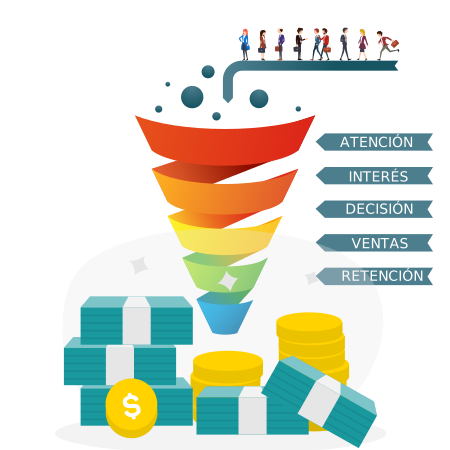
Generally speaking, a potential customer should go through 5 funnel stages, although this will depend on the business model:
Stage 1: Attention or first contact
This would correspond to all the actions we would use to make ourselves known. These actions could be:
- Use of social media
- Ad campaigns
- SEM
- SEO
- Link building
Continuing with the previous example, a valuable link in a blog related to our niche would be a good way to get a prospect or visitor. Imagine we are a travel agency specializing in nature tourism; it would make sense to think that a customer reading nature articles might be interested in going on a safari in Africa. Then, we could try to negotiate with a nature blog to include a link to our website. These link-building campaigns are quite effective because they convey trust, as well as qualified traffic.
Stage 2: Generate interest in visitors
Once we have managed to attract our buyer persona, what will make them stay with us and click on our products? How do we keep them from going to the competition? Well, all those actions would fall into this stage.
Generally, here we would try to get the potential customer to give us some contact information so we can do remarketing, that is:
- Newsletter subscription
- Discount coupons
- 1 month free trial
- “Leave your phone number and we’ll call you at no cost”
Our goal is for customers to give us an email address or phone number so we can contact them automatically in the future. At this stage, our buyer persona becomes a qualified lead.
Stage 3: Generate the decision to buy – the power of remarketing with customers
Now the potential customer has added products to the cart, but, ah! Damn, they do not confirm the purchase!
Relax. All, absolutely all leads, create quotes by adding products to the cart and then removing them.
On countless occasions, we will lose the sale, what is known as cart abandonment. And, my friend, this is where we have to analyze what is happening in the funnel and how we can fix it so that we increase conversion as much as possible.
All the actions that lead the customer to end up confirming the purchase, that is, converting, are the ones that belong in this stage of the sales funnel. Here we would be talking mainly about a remarketing stage. Continuing with the example above, this would include:
- email with the products urging them to confirm the purchase they abandoned
- email creating a kind of alarm warning that others are going to take the products they left in the cart (last units)
- email with complementary products (this is the one I like least because it creates a different sales process) – a kind of cross-selling
Stage 4: Sales – closing the sale or conversion
At this stage, we would include everything needed for the customer to complete the sale, that is, to achieve that desired conversion. Generally, CTAs help a lot with conversion, for example, a discount coupon.
Here the lead ends up becoming a customer.
A very clear example today would be utilities companies. Take Endesa, for example: you complete the online signup and if there is an error they call you by phone to try to close the deal over the phone. Why? Very simple: they have a management system that detects empty or abandoned carts (transactions not processed due to errors) and automatically triggers an alert so they can call you and try to close the agreement by phone. Pretty effective, don’t you think?
Stage 5: Retention – we want the customer to buy again
The customer is already ours, hooray, hooray, hooray, but don’t celebrate too soon. It took us a lot to get them to buy from us, but once they are a customer, they are always special, why?
Because they no longer have to go through stages 1 and 2. Directly, whenever they want to solve their problem with us, they will go to stage 3. And this translates into less time and, therefore, lower cost. That is why it is always easier to keep a customer than to get a new one, and that is where the biggest secret of a conversion funnel lies: once the customer is ours, make the most of them and try to turn them into a repeat customer. una vez el cliente es nuestro, rentabilízalo al máximo e intenta que se convierta en recurrente.
Creating a good customer experience
At this stage, the customer is testing the product or service, and creating a good experience is essential. In this stage, a good remarketing campaign would be important so they value our service, for example, or sending them an email after 1 week to see if they need a complementary product.
For example: imagine a customer buys a laptop. A week after buying it, we could send an article about the best mice on the market, and in 2 weeks we could send them an offer for a super gaming mouse.
Once they are in, if we have built the funnel well, we should offer complementary products to do cross-selling, that is, a cross-sell, such as a mouse pad, a gaming chair, a computer monitor, tools for YouTubers, etc. See?
We try to make sure our customer never leaves us and that their experience is perfect: taking care of your customers is your best investment.
Programs that will help you follow a good sales funnel
There are several very good platforms on the market, but our favorite and the one we recommend is Hubspot. It has a free version that works wonderfully and can be integrated with powerful external tools.
On the other hand, it allows you to generate banners and tracking codes on the different pages of your website to obtain metrics from your users and know at all times very valuable information such as which stage of the sales funnel the lead has reached.
It is true that the automations are paid and, by the way, quite expensive. But the free version is quite complete and allows you to build a good marketing funnel.
Conclusion
As you have seen, a sales funnel is nothing more than a way to take your potential customers step by step to the stage where they buy your products.
It is structured in 5 stages:
Attention: where we capture traffic and are already presenting our product or service.
Interest: Here the user becomes a lead and starts giving us information about themselves, such as their name and email.
Decision: At this stage, we nurture them with valuable information so they do not forget us and are ready to buy.
Sales: Here the lead ends up becoming a customer.
Retention: We want the customer to buy again.
To achieve a good funnel, we must use tools such as Hubspot or ActiveCampaign, since they allow us to obtain metrics from our users and know at all times very valuable information such as the bounce rate or which stage of the funnel the lead has reached, so that we can contact them with valuable information and try to get them to come back to our website and complete the sale.
We hope we have helped you better understand what a sales funnel is and how it works. Without a doubt, a fundamental tool for improving company metrics.